
IB Maths: AA vs AI — Which Should You Choose?
Two very different maths courses hide behind one IB subject slot. Here's what each one actually demands — and which fits your child's degree plans.
Written by the Shrividhya faculty — subject specialists teaching IB Diploma and IGCSE, and the SAT, GRE, GMAT and UK admissions tests, 1-on-1 and online. Every article is reviewed by founder Vidit Aggarwal before it is published. More about Team Shrividhya →
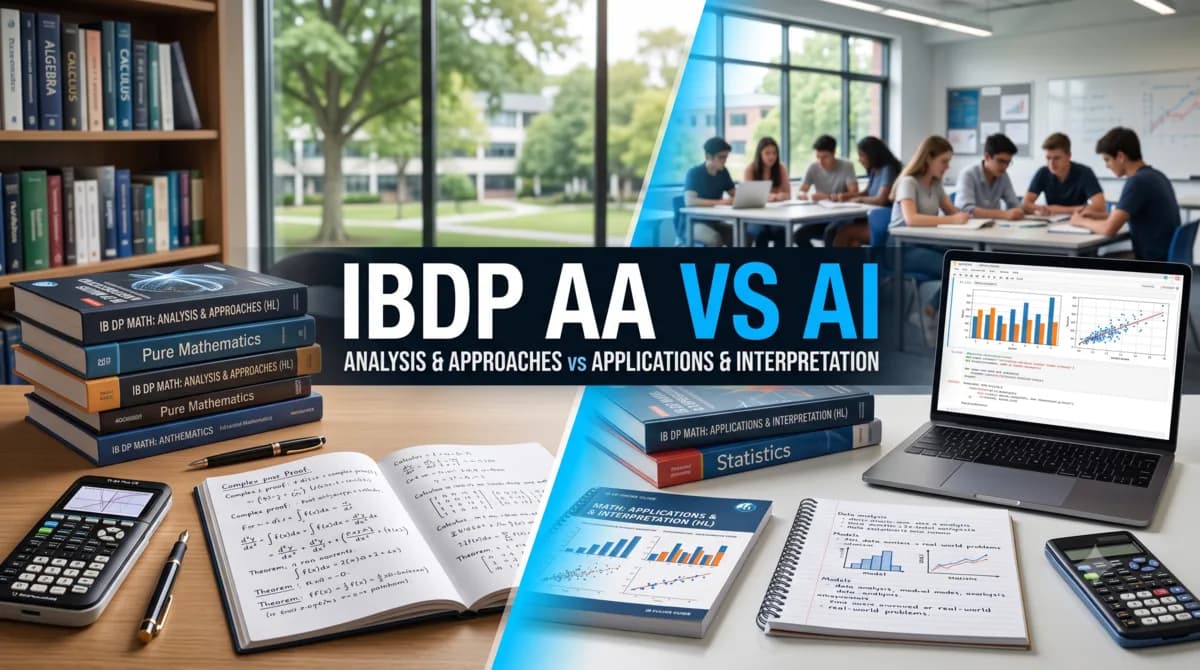
Every IB family reaches this fork: “Our school offers Maths AA and Maths AI, at HL and SL. Which one should we pick — and does it matter?”
It matters a great deal — and most families walk in with one assumption I need to correct immediately: that AI is the easier option. It isn't. Having taught both courses, I'd put AI HL on the same tier of difficulty as AA HL — just a different kind of hard. Treat it with that respect, or it will surprise you.
Unlike most IB subjects, mathematics splits into two genuinely different courses — Analysis and Approaches (AA) and Applications and Interpretation (AI) — each offered at Higher Level (HL) and Standard Level (SL). They share a name and a slot on the timetable, but they teach different maths, reward different strengths, and open different university doors.
This guide is what I actually tell families: why “AI is easier” is the wrong starting assumption, the real differences between the two courses, and how to choose based on where the student is headed rather than which course sounds harder.
Quick answer — AA vs AI at a glance
| Analysis & Approaches (AA) | Applications & Interpretation (AI) | |
|---|---|---|
| Emphasis | Pure maths — algebra, calculus, proof | Applied maths — statistics, modelling, real-world data |
| Best for | Engineering, maths, physics, economics, CS | Social sciences, business, design, natural sciences |
| Calculator | One no-calculator paper (Paper 1) | Calculator (GDC) on every paper |
| Heaviest topics | Calculus, functions, trigonometry, proof | Statistics, financial maths, modelling, graph theory (HL) |
| Levels | HL (240 hrs) & SL (150 hrs) | HL (240 hrs) & SL (150 hrs) |
| Internal Assessment | 20-hour Exploration (20% of grade) | 20-hour Exploration (20% of grade) |
The one-line version: AA is for students who like maths as a structured, abstract discipline; AI is for students who like maths as a tool to model and interpret the real world. Neither is “better.” The wrong question is “which is easier?” — the right one is “which fits the student, and which does their degree require?”
Mathematics: Analysis and Approaches (AA)
AA is the closest IB equivalent to a traditional pure-maths course. It develops mathematical argument, technique and generalisation — the kind of maths you need when you go on to study a subject where maths is the engine, not the accessory.
AA at a glance
- Core flavour: algebra, functions, sequences, trigonometry, calculus, and proof
- Distinctive feature: a no-calculator paper that tests fluency and method by hand
- HL goes further: deeper calculus, proof by induction, complex numbers, and vectors
- Lighter on: statistics and real-world modelling (present, but not the focus)
AA HL is often assumed to be the most demanding maths course in the IB — and it is genuinely tough. The step from SL to HL is real: HL adds a third paper (Paper 3), more abstract content, and a faster pace. It is the natural continuation for a student who already enjoys IGCSE Additional Maths (0606) or A-Level-style problem solving. But “most demanding” doesn't mean AI HL is a lesser challenge — see below.
Mathematics: Applications and Interpretation (AI)
AI teaches maths as a practical, modelling discipline. It leans into statistics, data, and technology, and it expects you to use a graphics calculator throughout. The misconception worth killing, and the one I correct with families most often: AI is not “maths for people who can't do maths.” Having taught both courses, I'd rate AI HL as demanding as AA HL, full stop — just differently. Go in expecting an easy ride and it will surprise you.
AI at a glance
- Core flavour: statistics, probability, financial maths, and mathematical modelling
- Distinctive feature: a graphics calculator (GDC) is allowed and expected on every paper
- HL goes further: graph theory, more sophisticated modelling, and complex statistical methods
- Lighter on: abstract proof and by-hand algebraic manipulation
AI suits students who are curious about the real world — economics data, scientific experiments, design, geography, business — and who think more clearly with a concrete context than with abstract symbols.
HL or SL? The second decision
Choosing AA or AI is only half of it. Within each, you pick Higher Level (240 teaching hours, three exam papers) or Standard Level (150 hours, two papers). A simple rule:
- Take HL if maths is central to your intended degree (STEM, economics, computer science), or if you genuinely enjoy and excel at it.
- Take SL if maths supports your path rather than leads it — and you need the time and points for your other Higher Levels.
A strong SL grade is worth more than a struggling HL grade — to your confidence, your overall IB score, and often to universities too. But check requirements first: if your target course demands HL, SL closes that door regardless of how high the grade.
Topic-by-topic comparison
This is where the courses visibly diverge:
| Topic area | AA (Analysis) | AI (Applications) |
|---|---|---|
| Calculus | Deep — differentiation, integration, by hand | Lighter — applied, calculator-supported |
| Algebra & proof | Central — manipulation, proof, induction (HL) | Minimal abstract proof |
| Statistics | Present but limited | Central — hypothesis tests, distributions, regression |
| Modelling | Some | Core skill — real-world functions & data |
| Financial maths | Not a focus | Included — loans, annuities, depreciation |
| Graph theory | Not covered | HL only — networks, trees, algorithms |
| Calculator use | One paper without it | Expected throughout |
Which one do universities want?
This is the part families most often get wrong — and it is where a tutor's honesty matters. Requirements vary by university, country and course, and they change year to year, so treat the below as the pattern and always verify the specific course page.
Engineering / Maths / Physics / Computer Science
- AA HL: the safe, expected choice — required by the most selective programmes (Oxford, Cambridge, Imperial and similar)
- AI HL: accepted by some, but a gamble for top STEM — don't assume
Economics
- AA HL: required or strongly preferred by mathematically intensive programmes (LSE, Cambridge, Warwick)
- AI HL: accepted by many strong economics degrees and well-suited to applied, data-driven economics
Medicine / Natural Sciences
- Either AA or AI is usually accepted; HL is sometimes required
- Chemistry/Biology focus means maths is supporting — choose by fit and grade ceiling
Social Sciences / Business / Design / Arts
- AI (HL or SL) is often the natural fit and fully accepted
- Statistics and modelling map directly onto psychology, geography and business
The thread running through all of this: AA HL keeps the most doors open. If a student is genuinely undecided and can cope with it, AA HL is the lowest-regret choice. If their direction is clearly applied or non-STEM, AI is not a compromise — it's often the better course. Mapping the choice to each student's target degree is exactly what we do in our online 1-on-1 IBDP programme, taught by our maths specialist faculty.
Decision guide: if your goal is X, choose Y
| The student's direction | Recommended choice | Why |
|---|---|---|
| Engineering, maths, physics, CS | AA HL | Required by top programmes; builds the calculus and proof they assume |
| Economics (top universities) | AA HL | Mathematically intensive courses expect it |
| Applied economics / business analytics | AI HL | Statistics & modelling map directly onto the degree |
| Psychology, geography, social sciences | AI (HL or SL) | Data and statistics are the maths these subjects use |
| Maths is a supporting subject only | AA SL or AI SL | Protect time and points for your leading Highers |
| Genuinely undecided, copes with maths | AA HL | The lowest-regret option — keeps every pathway open |
The mistakes I see most often
- Picking AI because it “sounds easier.” It isn't. AI HL is as demanding as AA HL, just in a different way — a student who dislikes statistics will not find it a soft option.
- Picking AA HL out of prestige when the degree plan is non-STEM and the HL workload crowds out subjects that matter more.
- Leaving university requirements until Year 2. By then the choice is locked. Check target courses before selecting.
- Confusing “good at maths” with “ready for AA HL.” Readiness is about fluency with algebra and calculus foundations — which is diagnosable, and fixable, early.
Frequently asked questions
Is IB Maths AA harder than AI?
This is the single biggest misconception families walk in with: that AA HL is the hard course and AI HL is the safe, easier option. It isn't. Having taught both, I'd put AI HL on the same tier of difficulty as AA HL — just a different kind of hard. AA tests abstract algebra, calculus and proof, including a no-calculator paper; AI tests deep statistics, modelling and data interpretation, and it deserves the same respect. Don't choose by which sounds easier — choose by where the student is headed: engineering, physics or research-focused degrees call for AA; finance and commerce-focused paths call for AI.
Can I study engineering with IB Maths AI?
Sometimes, but it's risky. Many engineering and physics degrees — especially selective ones like Oxford, Cambridge and Imperial — require Analysis and Approaches at Higher Level (AA HL). Some universities accept AI HL, but AA HL keeps every door open. If engineering, maths, physics or computer science is a possibility, AA HL is the safe choice.
Which IB maths is best for economics?
It depends on the university. Top economics programmes (LSE, Cambridge, Warwick) often require or strongly prefer AA HL because their courses are mathematically intensive. Many other strong economics degrees accept AI HL, which suits applied, data-heavy economics well. Economics is the subject where the AA-vs-AI decision matters most — check the specific course requirements.
Should I take IB Maths at HL or SL?
Take HL if maths is central to your degree plans or you genuinely enjoy and excel at it. Take SL if maths is a supporting subject, or if HL would crowd out other subjects you need. A strong SL grade beats a struggling HL one — but confirm your target courses don't require HL before deciding.
Can I switch from AA to AI partway through the IB?
It's possible early in the first year but gets harder as the syllabi diverge. If you're unsure, start in AA — moving AA → AI is easier than the reverse, and AA keeps more options open. Always talk to your IB coordinator and tutor before switching.
Still weighing AA vs AI, or already chosen and want to get ahead? We teach IB Maths AA and AI, HL and SL, online and 1-on-1 — mapping the course to each student's target degree. Learn about IB maths tutoring → Aiming at a maths-heavy UK course? See our AA HL + TMUA preparation → Need support across other IBDP subjects too? See IBDP tutoring across all five subjects →
Start with a free demo.
We'll assess where your child stands and build a focused 1-on-1 plan.